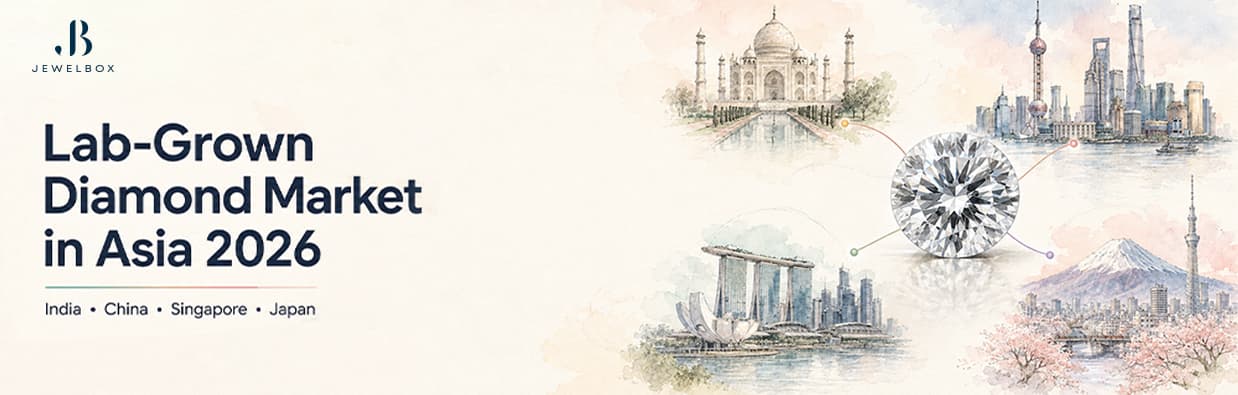
Asia decides where most of the world's lab grown diamonds come from and where a growing share of them get sold. The lab grown diamond Asia market 2026 picture shows four very different countries playing four very different roles. China grows the rough. India cuts, polishes and increasingly wears the finished stone. Singapore certifies and trades it. Japan buys it for precision and craftsmanship.
This piece breaks down where each market stands right now, using the latest industry data, so buyers get a clear, honest picture before choosing where their diamond actually came from.
Asia leads the global lab grown diamond market
Asia Pacific held a 34.52% share of the global lab grown diamond market in 2025, making it the largest region by revenue (Fortune Business Insights). The regional market is projected to touch USD 11.81 billion by 2026 and is expected to grow at a CAGR of 24% between 2026 and 2033, the fastest pace of any region (Precedence Research, 2026).
Three forces drive this: large-scale manufacturing in China and India, rising middle class incomes across the region, and government support for domestic lab grown diamond production.
China as the production engine behind the Asia lab grown diamond growth
China supplies roughly 63% of the world's lab grown diamond rough, with about 80% of that output coming from Henan province alone. Zhengzhou, the province's manufacturing hub, now hosts over 120 companies across the diamond growing supply chain.
This scale has pushed global diamond prices down more than 40% since 2022, forcing established players to rework pricing strategies (China Daily Brief). Most of this rough stone travels to India for cutting and polishing before reaching consumers worldwide.
Lab diamond market: India China Comparison
India's role has shifted fast. In FY 2025-26, GJEPC data shows polished lab grown diamond exports at USD 1.13 billion, a slight dip from the previous year even as export volumes rose, a sign of price correction rather than falling demand.
The real story, though, is happening at home. India's own market for lab grown diamond jewellery is on track to hit USD 453.7 million in 2026, and it's being led by buyers in Mumbai, Delhi and Bangalore who are picking up lab grown stones for everyday wear and travel, not just weddings. Something else worth noting: in March and April 2026, India's lab grown diamond export volume actually crossed natural diamonds for the first time ever. That is not a small shift. It tells you exactly where this industry is headed.
Jewelbox has witnessed this shift closely across its India stores, where lab grown diamond jewellery now sits alongside traditional gold pieces as an everyday choice rather than a niche one.
Singapore as Asia's certification and trading checkpoint
Singapore is not trying to compete with China or India on manufacturing. It plays a different role, and it plays it well. Buyers there care about one thing above everything else: trust. That is why most will not even look at a stone unless it comes with an IGI or GIA certificate. IGI clearly sees this too, and has been showing up more in the region, including investor meetings in Singapore during the Nuvama India Conference in August 2026. Over time, Singapore has become less about growing diamonds and more about proving they are what they claim to be. For a lot of Southeast Asian buyers, that is exactly what they show up for.
Japan as a precision cutting center
Japan's lab grown diamond market was valued at USD 1.21 billion in 2025, close to 4.14% of global market revenue. Japanese buyers favour high quality, precision cut HPHT stones, and the country remains one of India's key export destinations for finished lab grown diamonds. Among current APAC lab grown diamond trends, Japan stands out for prioritizing craftsmanship and technical sophistication over price alone.
What does this mean for lab grown diamond buyers in India?
For Indian buyers, this comparison matters beyond curiosity. Knowing that most rough stones originate in China and get finished in India helps explain pricing, while certification practices used in Singapore and Japan set a useful benchmark for what a trustworthy purchase should look like. Tracking Asia lab grown diamond growth across these markets makes one thing clear: certification and transparency are becoming the real differentiators, not just origin. That is exactly why Jewelbox sources IGI certified lab grown diamonds and follows the same verification standards buyers trust across these established markets. Customers get that peace of mind without having to do the market research themselves.
FAQs
1. Which Asian country produces the most lab grown diamonds?
That would be China, by a wide margin. It accounts for roughly 63% of the world's lab grown diamond rough, and most of that comes from one province, Henan.
2. Is India a producer or a buyer of lab grown diamonds?
Honestly, both. India cuts and polishes more lab grown diamonds for export than any other country, but it is also building a real domestic appetite for them, one that is expected to reach USD 453.7 million in 2026.
3. What makes Japan's lab grown diamond market different?
Japanese buyers are not chasing the lowest price. They want precision cutting and real craftsmanship, which is part of why Japan remains a key export market for high quality HPHT stones coming out of India.
4. Are lab grown diamond prices dropping across Asia?
Yes, and it is a noticeable drop. China's growing production capacity has pushed global prices down more than 40% since 2022, and even India's export values have softened a bit, even as the volumes keep climbing.
5. Is it safe to buy lab grown diamonds from India?
It is, as long as you are buying from a certified seller. Always check for IGI or GIA certification. That is the standard Jewelbox sticks to at every one of its stores.