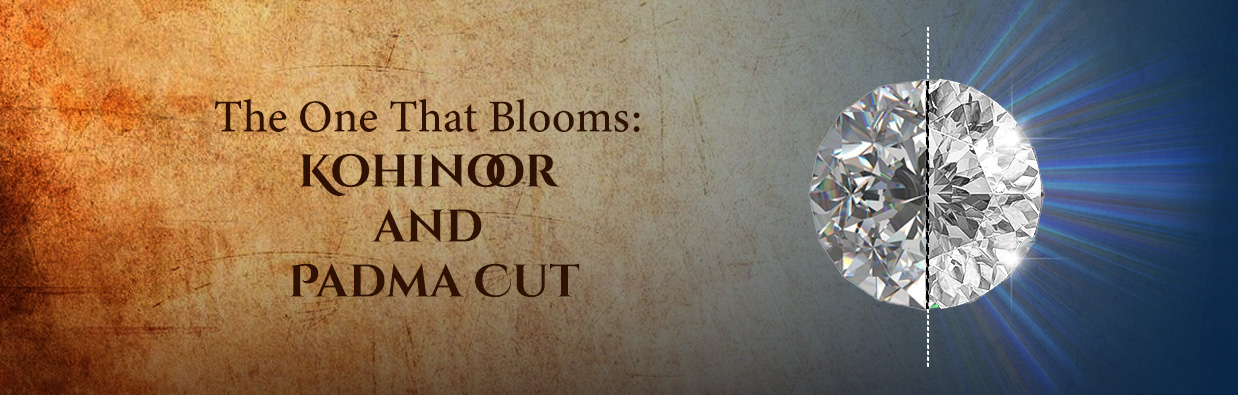
Ever wondered about the bejewelled origins of Kohinoor and Padma Cut Diamond? For centuries, India has been called the land of diamonds. From the fabled mines of Golconda that gave the world the Kohinoor, to today’s visionary craftsmanship that birthed the Padma Cut, India’s relationship with light, beauty, and symbolism runs deep. One has its origins in the rich history, and another one is purely a result of innovation, standing as glittering bookends to the story of India’s evolving artistry.
The Kohinoor diamond, as mentioned, was supposed to have been mined from the Kollur mines of the Golconda caves. It has passed through the hands of Mughal emperors, Persian rulers, Sikh Maharajas, and British monarchs.
Considering its size, status, and brilliance, the Kohinoor is considered a symbol of power, empire, and contested history. The Kohinoor Diamond stands as a testament to the gemstones that have shaped the shifting tides of dominance and destiny across centuries.
Originally, the Kohinoor diamond was believed to weigh over 180 carats before it was re-cut to its current oval shape. Unlike today’s precision cuts, its early form reflected the natural charm of hand-polished Indian craftsmanship, an era when diamonds were valued more for their mystique than mathematical perfection.
Fast forward to the present day, and the Padma Cut represents a rebirth of Indian design sensibility. Inspired by the Padma, or lotus flower, India’s national symbol of purity, beauty and national awakening.
The Padma-cut diamond is a remarkable result of a modern diamond design philosophy. Each diamond is shaped with meticulously aligned facets that radiate from the centre, mimicking the unfolding petals of a lotus in bloom. The result is a uniquely soft, luminous brilliance, distinct from the sharp sparkle of round or princess cuts.
A Diamond With Many Thrones: The Kohinoor Diamond
Having its origin in India, the Kohinoor diamond happens to be the most travelled diamond through countries, continents and empires. The Kohinoor diamond’s journey can be read like an epic saga, spanning centuries of power and conquest. From the glittering courts of the Mughal emperors, where it once shone in the Peacock Throne, to the treasuries of Persian and Afghan rulers, it has witnessed the shifting tides of empire.
At last, it came into the possession of Maharaja Ranjit Singh, the Lion of Punjab, symbolising Sikh pride and sovereignty. Eventually, through the annexation of Punjab, it found its way into the British Crown Jewels, where it now rests, set in the crown of Queen Elizabeth the Queen Mother. After her, it was worn by King Charles the Third.
It is only a few diamonds in history which is as travelled as Kohinoor, crossing so many borders, thrones, and dynasties. With the rulers viewing it as a mark of divine right and dominion.
Inspired By the Sanskrit Lores and Ancient Ideals, The Padma Cut Diamond
The Padma cut is an inspiration drawn from our national flower, the lotus, a symbol that has long been the muse of nature to artists, poets, and musicians alike. Loved by people across faiths and generations, the lotus finds its place in Mughal miniature paintings and is revered in the Vedas, where sages offered it to the divine in sacred rituals.

This enduring flower, rising pristine from still waters, embodies purity, renewal, and grace values deeply rooted in India’s cultural and spiritual fabric. Translating this forever symbolism into gemstone form, modern craftsmen have created the Padma Cut diamond, a contemporary marvel that reflects both devotion and design mastery. Each facet unfurls like a lotus petal in bloom, radiating a soft, harmonious light that feels both serene and powerful.
Read more: 5 Ways Padma Cut Diamonds are Unique and Different from Others
Reborn Through the Ages: The Kohinoor Diamond
The Kohinoor wasn’t always the refined oval cut we recognise today. In its earliest form, the Kohinoor diamond was an irregular, flat, rose-cut stone weighing close to 793 carats, typical of the traditional Indian style of polishing, which focused on preserving size and surface lustre rather than achieving optical symmetry. It shimmered with a soft, diffused glow, less fiery than today’s cuts, but mesmerising in its own quality.

When the diamond came into British possession after the annexation of Punjab in 1849, it was displayed at the Great Exhibition of 1851 in London. To the disappointment of many visitors, the Kohinoor’s brilliance seemed muted under England’s dim skies. Queen Victoria’s husband, Prince Albert, believed its full potential was hidden beneath the ancient cut. Determined to enhance its sparkle, he entrusted the diamond to Voorsanger & Coster of Amsterdam, one of the era’s most skilled diamond-cutting firms.
After 38 days of meticulous recutting, the Kohinoor emerged in a new form, a dazzling oval brilliant cut weighing 105.6 carats. Although it lost more than half its original weight, the transformation revealed a sharper, more radiant fire within. Today, the Kohinoor’s recut brilliance continues to draw awe and debate, a gemstone forever shaped by the hands of time, artistry, and empire.
Every Padma Cut Diamond Is Slightly Unique
One of the most captivating qualities of the Padma Cut diamond is that no two are ever the same. Unlike traditional cuts, which follow precise mathematical proportions to achieve uniform brilliance, the Padma Cut draws from natural symmetry inspired by the organic geometry of a blooming lotus.
Each padma cut diamond is handcrafted with delicate variations in its facet arrangement, allowing the diamond cutter to respond to the raw gem’s natural shape, inclusions, and inner light. This process ensures that every Padma Cut diamond carries its own character, much like how no two lotus flowers ever bloom in the same way.
The result is a diamond that feels deeply personal, one that glows differently under changing light, revealing new dimensions of sparkle with every movement. It’s a subtle celebration of individuality, reminding us that true beauty lies not in perfection, but in the uniqueness that sets each creation apart.
Eternal Facets of Brilliance From India: Kohinoor and Padma Cut Diamond
India is a land of diamonds, and both have given birth to the everlasting shimmering Kohinoor and the multi-faceted Padma Cut diamond, two creations that embody the nation’s relationship with light and beauty throughout history. The Kohinoor stands as a symbol of India’s royal past, carrying within its facets stories of empires, power, and prestige.
The Padma Cut, meanwhile, reflects the country’s modern spirit rooted in heritage yet reborn through innovation and artistry. One glows with the weight of history, the other blooms with the promise of renewal. Together, they capture the essence of India’s gleaming journey where every facet tells a story of legacy, craftsmanship, and eternal grace.